Book Appointment Now

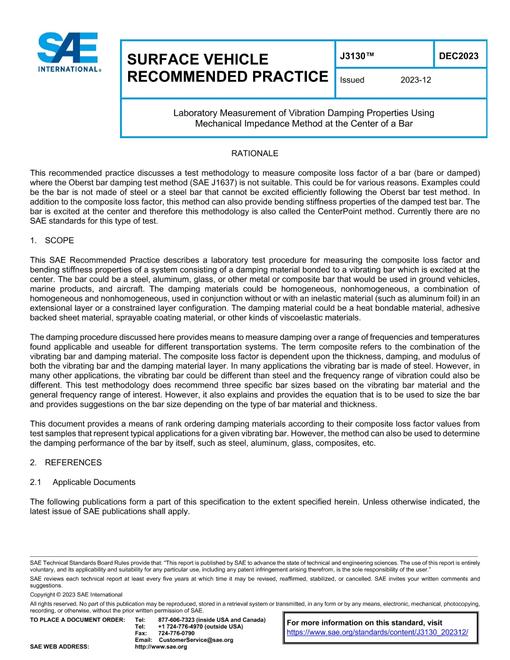
SAE J3130_202312
Original price was: $108.$65Current price is: $65.
Laboratory Measurement of Vibration Damping Properties Using Mechanical Impedance Method at the Center of a Bar
| Published by | Publication Date | Number of Pages |
| SAE | 2023 | – |
SAE J3130 – Laboratory Measurement of Vibration Damping Properties Using Mechanical Impedance Method at the Center of a Bar
This SAE Recommended Practice describes a laboratory test procedure for measuring the composite loss factor and bending stiffness properties of a system consisting of a damping material bonded to a vibrating bar which is excited at the center. The bar could be a steel aluminum glass or other metal or composite bar that would be used in ground vehicles marine products and aircraft. The damping materials could be homogeneous nonhomogeneous a combination of homogeneous and nonhomogeneous used in conjunction without or with an inelastic material (such as aluminum foil) in an extensional layer or a constrained layer configuration. The damping material could be a heat bondable material adhesive backed sheet material sprayable coating material or other kinds of viscoelastic materials.
The damping procedure discussed here provides means to measure damping over a range of frequencies and temperatures found applicable and useable for different transportation systems. The term composite refers to the combination of the vibrating bar and damping material. The composite loss factor is dependent upon the thickness damping and modulus of both the vibrating bar and the damping material layer. In many applications the vibrating bar is made of steel. However in many other applications the vibrating bar could be different than steel and the frequency range of vibration could also be different. This test methodology does recommend three specific bar sizes based on the vibrating bar material and the general frequency range of interest. However it also explains and provides the equation that is to be used to size the bar and provides suggestions on the bar size depending on the type of bar material and thickness.
This document provides a means of rank ordering damping materials according to their composite loss factor values from test samples that represent typical applications for a given vibrating bar. However the method can also be used to determine the damping performance of the bar by itself such as steel aluminum glass composites etc.
Product Details
- Published:
- 12/20/2023
- File Size:
- 1 file 570 KB
- Note:
- This product is unavailable in Ukraine Russia Belarus